

Hydrocooling Water Level Control System
Project in a Nutshell
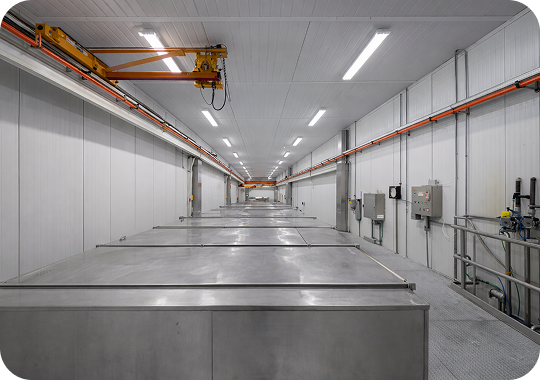
Glen Rock Hams upgraded the control system for its hydrocooling process — a production step where packaged ham is rapidly cooled by immersing it in cold water. The cooling system used three interconnected water tanks with a shared circulation loop, supported by pumps, valves, and sensors.
The implementation made the process stable, safe, and easier to run by introducing a clear operator interface and automation that kept water levels balanced, maintained proper circulation, and flagged abnormal conditions early.
Client & Challenge
Hydrocooling looked straightforward on paper (“keep product in cold water”), but in real production it behaved like a live system that could drift out of balance quickly.
The main challenges were:
Making operations repeatable across shifts
Without automation and clear UX, performance depended too much on individual operator habits. The plant needed a consistent way of working regardless of who was on shift.
Preventing overflow and water waste
When water levels rose too high, the plant risked overflow, cleanup, and downtime. When levels dropped too low, product coverage and cooling effectiveness could suffer.
Keeping the system stable across multiple tanks
Because the tanks were connected, changes in one tank affected the others. Manual adjustments often led to over-correction, uneven levels, and unstable circulation.
Maintaining consistent cooling performance
Cooling quality depended not only on temperature, but also on water circulation. Poor circulation could create hot spots and uneven cooling during peak production.
Solution
Since the camera was developed from scratch, it initially did not support ONVIF. This limited its integration potential with popular VMS and NVR systems. The client needed:
Auto Level Balancing
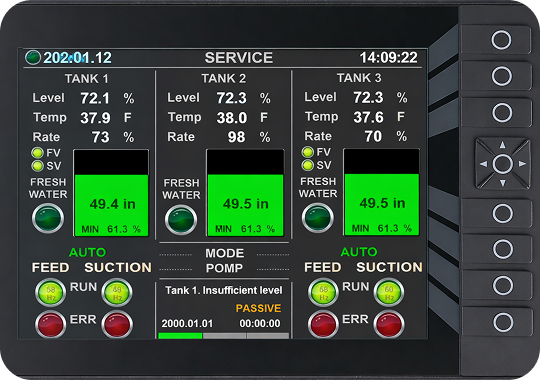
AUTO mode continuously kept water levels balanced across all three interconnected tanks. It adjusted pump operation to correct drift and helped prevent system-wide overfill or low-water conditions without constant operator intervention.
Manual Control (Safe Backup)
MANUAL mode gave operators direct control when troubleshooting or handling unusual situations. Even in manual operation, the system continued monitoring key conditions and surfaced alarms if levels moved outside safe limits.
Operator Visibility & Settings
The operator interface displayed clear per-tank status (levels, pump states, and key indicators) and centralized messages/alarms for fast response. Critical configuration settings were protected to prevent accidental changes and keep operation consistent across shifts.
Alarms & Message Log
A dedicated Messages area displayed active warnings and a clear history of events during the current session. This helped operators acknowledge issues quickly, understand what happened, and respond consistently instead of relying on verbal handoffs or guesswork.
Technical Highlights
IFM-based hardware stack
Built on IFM sensors and I/O for reliable plant operation and easier maintenance.
IO-Link-ready integration
Standardized device connectivity with better diagnostics and faster replacement/commissioning.
CODESYS control layer
Control logic implemented in CODESYS for deterministic behavior, clear mode handling, and long-term maintainability.
State-accurate HMI
The UI reflected real device states and alarms, improving operator confidence and troubleshooting speed.
Business Value
The client aimed to expand their market reach and enhance product compatibility with widely used surveillance systems. Implementing the ONVIF Profile S standard was key to integrating their camera into existing security ecosystems regardless of the equipment brand.
With ONVIF integration, the client unlocked several benefits:
– Increased product value for end-users and system integrators
– Minimal integration costs with smart building systems, IoT platforms, and cloud services
– Out-of-the-box compatibility with IP surveillance systems (cameras + NVRs)

Conclusion
The project successfully turned hydrocooling into a stable, well-instrumented, operator-friendly system. With automatic level balancing, controlled manual fallback, service fill support, and clear alarms and protected settings, Glen Rock Hams achieved more reliable operations, fewer interruptions, less waste, and more consistent cooling performance across every shift.
DO YOU HAVE A SIMILAR PROJECT IDEA?
No matter how complex your IT project goals are, our professional business analysts will increase the product quality while reducing its costs.
OUR HEADQUARTERS
We are open to new challenging tasks and we'd love to learn more about your project.


