
Software product development is the process of designing, building, and launching a software product – from the initial idea through to a live, maintainable system used by real customers. It’s distinct from custom software development for internal use, and it’s distinct from maintaining or extending an existing system.
The goal is a product: something that delivers value to users, can be iterated on, and can scale.
This guide covers what software product development actually involves, how it differs from other types of software work, and what to look for when choosing a partner to build your product.
Software Product Development vs Custom Software Development
These terms are often used interchangeably, but they describe different things.
Custom software development typically refers to building software to solve a specific internal problem for one organization – a custom ERP, an internal workflow tool, a bespoke reporting system. The “customer” is the organization itself. Success means the system works for the people who use it internally.
Software product development means building software that will be used by external customers – people or businesses who choose to use your product, often in competition with alternatives. Success means users adopt it, retain it, and ideally pay for it. The product needs to be intuitive enough for people who weren’t involved in building it, reliable enough to trust with real business operations, and differentiated enough to compete.
The distinction matters because the standards are different. Internal tools can tolerate rough edges that external products cannot. User experience, onboarding, performance, and reliability matter far more when you’re competing for customers than when you’re serving a captive internal audience.
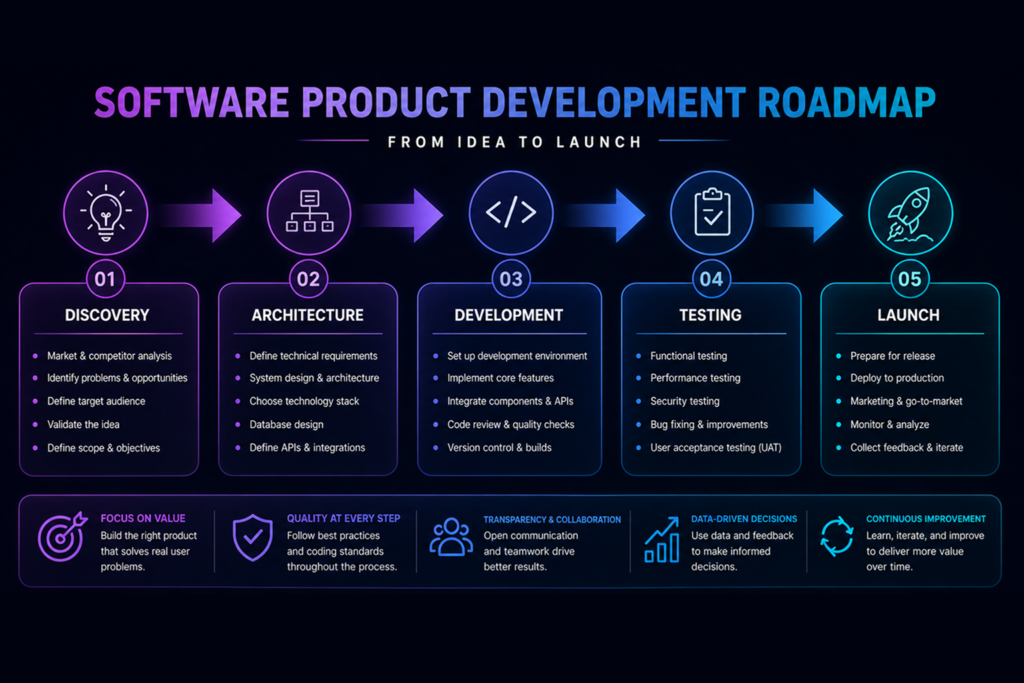
The Stages of Software Product Development
Discovery and Definition
Before writing code, a well-run product development process starts with understanding the problem. This means talking to potential users, mapping existing workflows, identifying the specific pain that the product will solve, and defining what success looks like.
The output of discovery is usually a product specification – a shared understanding of what will be built, for whom, and why. This doesn’t need to be a hundred-page document; it needs to be specific enough that the development team can build the right thing, and flexible enough to evolve as you learn more.
Skipping discovery is the most common reason software products fail. Teams build the product they imagined rather than the product users actually need.
Architecture and Technical Design
Once you know what you’re building, the technical approach needs to be defined. This includes technology stack selection, system architecture, data model design, integration requirements, and infrastructure approach.
Technical decisions made early are expensive to change later. A monolithic architecture that’s fast to build initially becomes a bottleneck at scale. A technology stack chosen because a developer knew it well may not be the right fit for the product’s long-term requirements. Good architecture work at the start prevents expensive rewrites later.
Development and Iteration
Modern software product development is iterative. Rather than building everything and launching once, the product is developed in increments – each delivering working, testable functionality. This allows real user feedback to shape the product as it’s built, rather than discovering problems after a large investment.
The right iteration cadence depends on the product and team. Two-week sprints are common. What matters is that each cycle produces something testable, feedback is gathered, and the next cycle incorporates what was learned.
Testing and Quality Assurance
Software products need to work reliably for users who aren’t developers and who don’t know how to work around bugs. QA in product development covers functional testing (does it do what it’s supposed to?), performance testing (does it handle real load?), security testing (is user data protected?), and usability testing (can real users accomplish their goals?).
Automated testing – unit tests, integration tests, end-to-end tests – is essential for products that will be maintained and extended over time. Without it, every change risks breaking existing functionality.
Launch and Post-Launch
Launch is not the end of software product development – it’s the beginning of the feedback loop. Real users use the product in ways that weren’t anticipated. Analytics reveal where users drop off. Support tickets surface pain points that testing didn’t catch.
Post-launch product development means responding to this feedback: fixing bugs, improving performance, adding features that users actually ask for, and removing features that nobody uses.
What Makes Software Product Development Succeed
Clarity on the problem being solved. Products that try to solve everything solve nothing well. The best products are opinionated – they make specific choices about who they’re for and what problem they solve better than alternatives.
User involvement throughout. Products built without user feedback tend to solve the problem the team imagined, not the problem users actually have. Regular user testing, even informal, dramatically improves the outcome.
Technical quality from the start. Moving fast by cutting corners on architecture, testing, and code quality is borrowing time from the future. Technical debt accumulated in the early stages becomes the constraint that prevents the product from evolving.
A realistic scope for the first version. The most successful product launches start with less than the team wanted to build. A focused MVP that does one thing well is easier to learn from than a broad product that does many things adequately.
Choosing a Software Product Development Partner
If you’re building a product with an external development team, what you’re looking for is different from what you’d look for in a staff augmentation provider or an agency building a marketing website.
You want a team that asks questions about the problem before proposing solutions. That pushes back on scope when it’s too broad. That has opinions about architecture and technology choices. That treats your product as if they have a stake in its success – because the best development partners do.
Questions worth asking:
- How do you handle requirements that change during development?
- What does your QA process look like?
- How do you make technical decisions when there are trade-offs?
- Can you show examples of products you’ve built that are in production and being actively used?
At PieSoft, we’ve built software products for startups and growing businesses across healthcare, logistics, sports analytics, and industrial applications – from early-stage MVPs through to scaled production systems. If you’re planning a software product and want a team that will engage seriously with the problem, get in touch.
Learn more about our custom software development services.


