
Every camera ships with ISP settings. Most of those settings were configured on a bench, under controlled lighting, with a reference sensor that may not be the exact unit in your product.
In the lab, they look fine. In the field – in your actual operating environment, across your actual temperature range, under your actual lighting conditions – they fall apart.
ISP tuning is the process of fixing that. It is the work that happens between “the camera captures an image” and “the image is actually good.” This article explains what that work involves, why it matters, and what separates professional tuning from the defaults that ship with every module.
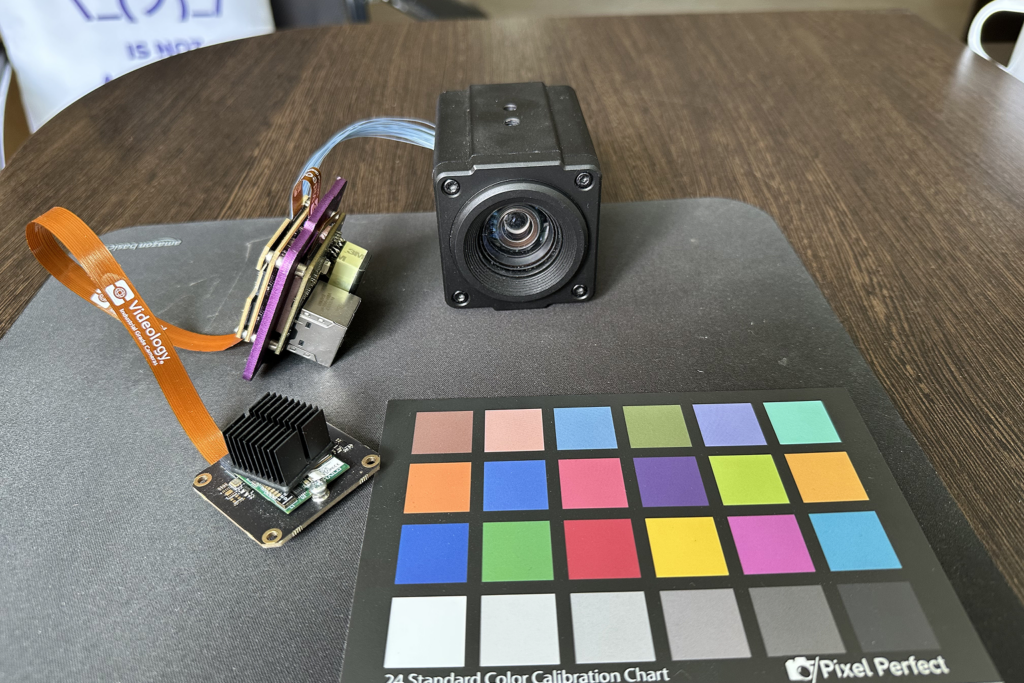
What Is an ISP?
The image signal processor (ISP) is the hardware or software pipeline that converts raw sensor output into a usable image.
A camera sensor does not produce photographs. It produces a grid of intensity values – one value per pixel, representing how much light hit that photodiode during the exposure. The values are raw, linear, and full of artifacts: noise, color cast, uneven illumination, and the pattern of the Bayer filter that separates red, green, and blue channels across the pixel array.
The ISP takes this raw data and processes it through a pipeline of stages:
Debayering interpolates the missing color values at each pixel. Each pixel captures only one color channel; the other two are estimated from neighboring pixels.
Black level correction removes the fixed offset in the sensor’s output – even with no light, pixels register a small non-zero value.
Lens shading correction compensates for uneven illumination across the frame. Lenses pass more light at the center than the edges; shading correction applies a per-pixel gain map to flatten the response.
White balance adjusts the relative gain of the red, green, and blue channels so that neutral objects — white paper, gray walls – appear neutral in the output.
Noise reduction suppresses random variation in pixel values caused by photon shot noise, read noise, and thermal noise.
Tone mapping converts the linear sensor output to a perceptually appropriate response curve. Human vision is logarithmic; a linear image looks flat and low-contrast.
Color correction transforms from the sensor’s native color space – determined by the spectral sensitivity of its photodiodes and color filters – to a target color space like sRGB or Display P3.
Sharpening enhances edge contrast to compensate for the softening introduced by debayering and noise reduction.
Each stage has parameters. Those parameters need to be set correctly for the specific sensor, the specific lens, and the specific operating environment. That is what ISP tuning is.
What Generic Settings Get Wrong
Every ISP ships with default parameters. For sensor manufacturers selling into the consumer market – smartphones, webcams, action cameras – these defaults are calibrated for typical conditions: indoor lighting at room temperature, common lens types, moderate frame rates.
For embedded camera products operating in different conditions, these defaults are a starting point at best and actively harmful at worst.
Noise reduction tuned for one noise profile performs poorly on another. Different sensors have different noise characteristics. Different gain levels produce different noise patterns. Noise reduction that works well at ISO 400 on one sensor may over-smooth at ISO 400 on another, destroying fine detail, or under-smooth, leaving visible grain.
White balance calibrated for one light source fails under another. A white balance tuned for daylight produces a strong color cast under industrial fluorescent lighting. A factory floor, a surgical suite, and an outdoor installation all have different lighting conditions that require different white balance calibration.
Tone curves designed for wide dynamic range displays look wrong on narrow dynamic range outputs. The tone mapping that looks good on a reference monitor may clip highlights or crush shadows on the target display.
Lens shading correction for one lens profile is incorrect for another. Shading is a property of the specific lens, not the sensor. A shading correction map calibrated for an 8mm f/2.0 lens produces shading artifacts when used with a 12mm f/1.8 lens.
The result is a camera that looks acceptable in the lab – under the conditions the defaults were designed for – and disappoints in the field.
What Professional ISP Tuning Involves
Professional ISP tuning is a systematic process of calibrating ISP parameters for a specific hardware combination and a specific set of operating conditions. It is not adjusting sliders until the image looks better. It is measurement-driven calibration against known references.
Color calibration
A color checker chart – a physical target with patches of known spectral reflectance – is photographed under controlled illumination. The ISP output is compared to the known values. The color correction matrix is computed to minimize the error between the camera’s output and the reference.
This process is repeated for each target illuminant – daylight, tungsten, fluorescent, LED – to build an illuminant-dependent color correction model.
White balance calibration
White balance gains are computed for each target illuminant. The camera’s auto white balance (AWB) algorithm is calibrated to correctly identify and adapt to each illuminant automatically.
Lens shading calibration
A uniformly illuminated white target is photographed. The spatial variation in output across the frame – which should be zero for a perfect lens – is measured and used to compute a per-pixel correction map.
Noise characterization
The sensor’s noise profile is characterized across the gain range: read noise, shot noise, and fixed pattern noise at each ISO level. Noise reduction parameters are tuned based on this characterization – aggressive enough to suppress visible noise without over-smoothing at each gain level.
3A algorithm tuning
Auto exposure (AE), auto white balance (AWB), and auto focus (AF) are control loops that continuously adjust camera parameters to maintain image quality as conditions change. Each loop has parameters – convergence speed, stability thresholds, search ranges – that must be tuned for the application.
An AE tuned for a consumer camera – which prioritizes avoiding dark images even at the cost of high gain – is wrong for a machine vision camera that requires controlled, predictable exposure for consistent measurement. An AWB that adapts quickly to changing illumination is right for a consumer camera but wrong for a camera that needs color stability across a shot sequence.
Validation across the operating range
Tuning done only at room temperature and nominal illumination is incomplete. A camera product that operates outdoors across a -20°C to +60°C range needs ISP parameters validated across that range. Dark current increases with temperature. Sensor gain characteristics shift. Lens focus shifts. The ISP parameters that produce good results at 25°C may produce visibly degraded results at 50°C.
The Difference Between Lab Performance and Field Performance
The gap between lab performance and field performance is the most common disappointment in camera product development. A camera that looks excellent in controlled evaluation fails to meet expectations in deployment.
The reasons are usually predictable:
Lighting. The lab used a color-calibrated reference illuminant. The field uses mixed LED and fluorescent lighting at varying intensities. The white balance and color correction that worked in the lab are wrong in the field.
Temperature. The lab evaluation was at room temperature. The deployed camera runs at 45°C inside its housing. Dark current has increased. Fixed pattern noise has changed. The noise reduction that worked at room temperature is now insufficient.
Lens variation. The lab used a sample lens from the same production run. The production cameras use lenses from a different run with slightly different shading characteristics. The shading correction map is wrong.
Gain. The lab demonstrated image quality at low gain, in well-lit conditions. The field application requires operation at high gain in low-light conditions. The noise reduction has not been tuned for the high-gain noise profile.
Professional tuning addresses each of these systematically – by characterizing the camera across the full range of conditions it will encounter and calibrating the ISP for each.
When ISP Tuning Matters Most
ISP tuning is not equally important for every application. It matters most when:
Color accuracy is a requirement. Medical imaging, food inspection, product photography, and any application where the camera’s output will be compared to a reference require accurate color. Untuned cameras have significant color error.
Low-light performance is a requirement. Noise reduction tuning is the primary determinant of how well a camera performs at high gain. Generic noise reduction either removes too much (destroying detail) or too little (leaving visible noise).
The operating environment differs from typical consumer conditions. Industrial, outdoor, and medical environments have lighting, temperature, and optical characteristics that differ from the conditions consumer ISP defaults assume.
Machine vision accuracy depends on image consistency. Inspection and measurement applications require consistent image output – the same object must produce the same pixel values across frames, across cameras, and across time. ISP tuning for consistency is different from ISP tuning for perceptual quality.
The product has high image quality expectations. Medical devices, professional video cameras, and consumer products in competitive markets cannot ship with mediocre image quality. The difference between acceptable and excellent is usually ISP tuning.
What the Process Looks Like in Practice
A professional ISP tuning engagement for a custom camera product typically runs four to eight weeks and involves the following:
Week 1-2: Hardware setup and characterization. The camera hardware is configured in a controlled environment. The sensor noise profile is characterized across the gain range. Initial raw captures are made for color and shading calibration.
Week 2-3: Color and shading calibration. Color correction matrices are computed for each target illuminant. Lens shading correction maps are computed. Initial AWB calibration is performed.
Week 3-5: 3A tuning. AE, AWB, and AF algorithms are tuned for the specific application requirements. Convergence speed, stability, and edge case behavior are validated.
Week 5-6: Noise reduction tuning. Noise reduction parameters are tuned for each gain level. The balance between noise suppression and detail preservation is set based on the application requirements.
Week 6-8: Validation and iteration. The tuned parameters are validated across the operating range – illuminants, temperatures, gain levels. Remaining issues are identified and corrected.
The deliverable is a parameter set that produces consistently good image quality across the conditions the camera will actually encounter – not just on a bench under ideal conditions.
What PieSoft Does
Our camera engineering team handles ISP tuning as part of custom camera development projects and as a standalone service for teams that have built camera hardware and need the image quality to match the hardware capability.
We work with the full range of common embedded camera platforms – NXP i.MX 8, Rockchip RK3566/RK3588, Amlogic A311D, NVIDIA Jetson – and with sensors from Sony, onsemi, and OmniVision across visible light, near-infrared, and industrial imaging applications.
If your camera hardware is capable of better image quality than it currently delivers, ISP tuning is usually where the gap is.
Summary
ISP tuning is the process of calibrating image signal processor parameters – color correction, white balance, lens shading, noise reduction, tone mapping, and 3A algorithms – for a specific sensor, lens, and operating environment. Generic defaults ship with every camera module and perform adequately under the conditions they were designed for. They fail in the field when operating conditions differ from those assumptions. Professional ISP tuning addresses this through measurement-driven calibration against known references, validated across the full range of conditions the camera will encounter. The result is a camera that performs consistently in deployment – not just on a bench.
Generic ISP settings fall short in real operating conditions. PieSoft tunes camera systems across the full range – every gain level, every color temperature, every condition your product will actually face.


