
Every growing business eventually outgrows its spreadsheets and needs a proper CRM. The question isn’t whether to get one – it’s whether to buy an existing solution or build one tailored to how your business actually works.
This guide breaks down the real differences, the trade-offs, and the signals that tell you which path makes sense.
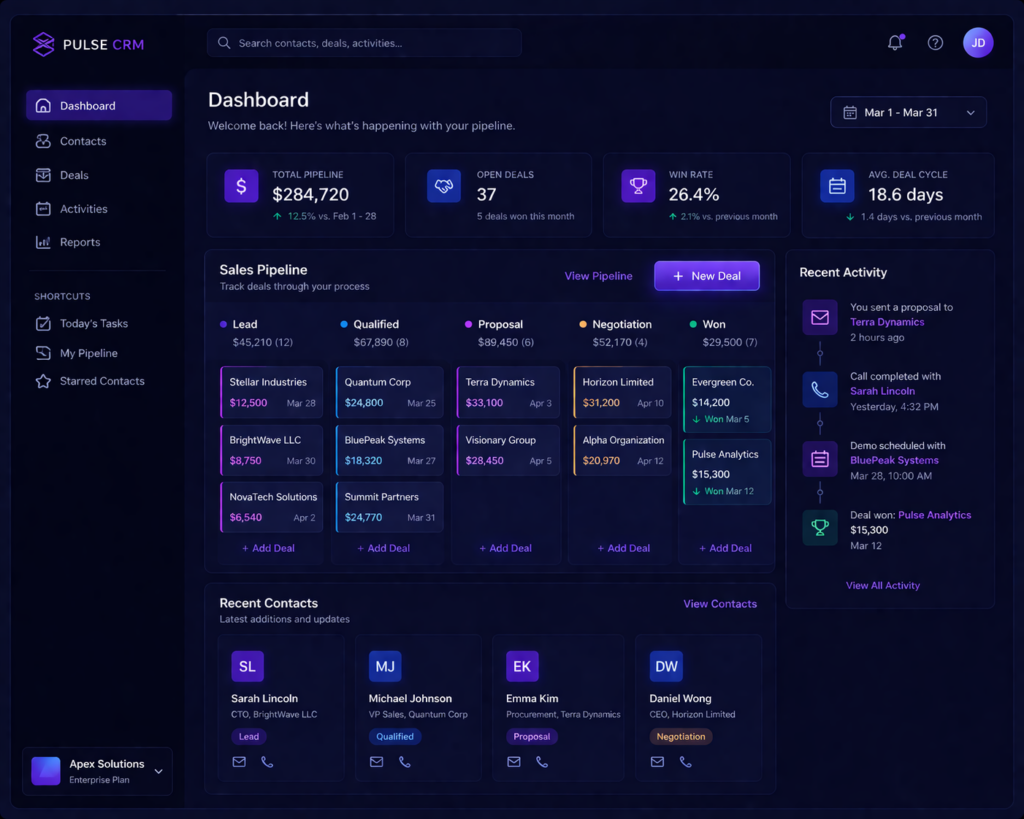
What Off-the-Shelf CRM Gets Right
Salesforce, HubSpot, Pipedrive, and Zoho exist because they solve real problems for a wide range of businesses. Off-the-shelf CRM works well when:
Your sales process is standard. If your team manages leads, tracks deals through stages, and logs calls and emails – every major CRM handles this well out of the box.
You need to move fast. A SaaS CRM can be operational in days. Custom development takes months. If speed to deployment matters more than perfect fit, off-the-shelf wins.
Your team is small. For teams under 10 people, the overhead of custom software often outweighs the benefits. The flexibility of an off-the-shelf tool with some configuration is usually enough.
Budget is tight upfront. SaaS CRM spreads cost over time as a subscription. Custom development requires upfront investment.
Where Off-the-Shelf CRM Falls Short
The limitations of off-the-shelf CRM become visible as businesses grow and their processes become more specific:
Your workflow doesn’t fit the CRM’s model. Every CRM is built around assumptions about how sales works. If your business has multi-stage approval workflows, complex pricing logic, project-based relationships, or industry-specific processes – you end up building workarounds, not workflows.
Integration is a constant battle. Connecting a CRM to your ERP, production system, custom portal, or legacy database through API integrations is expensive, fragile, and requires ongoing maintenance as both systems update.
Data ownership and portability. Your customer data lives in a vendor’s system. Migrating away is difficult by design. If the vendor raises prices, changes terms, or discontinues the product, your options are limited.
Per-seat costs scale poorly. At 5 users, $50/seat/month is manageable. At 100 users, you’re paying $60,000 per year for software that still doesn’t quite fit your process.
You pay for features you don’t use. Enterprise CRM tiers include hundreds of features. You use twenty of them. The rest is noise, complexity, and cost.
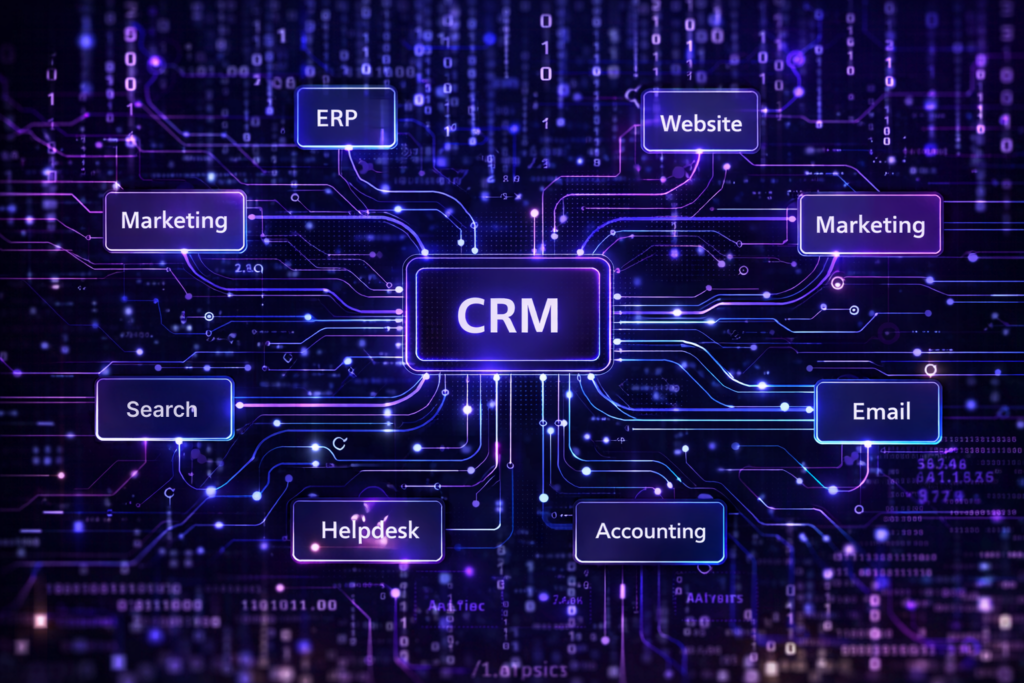
What Custom CRM Development Gives You
A custom CRM is built around your specific business – your terminology, your workflows, your data model, your integration requirements.
Exact process fit. The system works the way your team works, not the way the vendor assumes you work. Onboarding is faster because the interface reflects real workflows.
Deep integration. Custom CRM can be built to integrate natively with your existing systems – your ERP, your production database, your customer portal, your billing system – without API glue code that breaks when either system updates.
Ownership and control. You own the code, the data, and the infrastructure. No vendor lock-in, no per-seat fees, no surprise price increases.
Built for your data model. If your business has complex relationships – multi-site clients, project hierarchies, product configurations, regulatory requirements – a custom data model handles this cleanly. Off-the-shelf CRM forces your data into its model.
Long-term cost advantage. Custom development has higher upfront cost but no recurring license fees. For businesses with 30+ users, the break-even point against enterprise SaaS is typically 2-3 years.
The Real Cost Comparison
Off-the-shelf CRM looks cheaper until you add up the full picture:
- License fees × seats × years
- Implementation and customization costs
- Integration development and maintenance
- Training costs as the platform evolves
- Data migration costs if you ever leave
Custom development has higher upfront cost but lower ongoing cost. The total cost of ownership over 5 years often favors custom for mid-size and larger teams – especially when the off-the-shelf solution requires significant customization to fit your process.-the-shelf solution requires significant customization to fit your process.
Signs You Need Custom CRM
- You’ve spent more than $50,000 customizing an off-the-shelf CRM and it still doesn’t work the way you need
- Your team maintains parallel spreadsheets because the CRM doesn’t capture what they need
- You have 3+ integrations to other business systems that require ongoing maintenance
- Your sales process is genuinely different from standard B2B SaaS
- You have compliance or data residency requirements that limit SaaS options
- You’re paying for 50+ seats of a platform where you use 20% of the features
How PieSoft Approaches Custom CRM Development
We’ve built CRM systems for healthcare, insurance, logistics, and professional services businesses — each with processes that off-the-shelf solutions couldn’t accommodate cleanly.
Our process starts with understanding how your business actually works: your sales stages, your data relationships, your integration requirements, and your reporting needs. We build to fit that reality — not to a generic template.
If you’re evaluating whether custom CRM makes sense for your business, get in touch – we’re happy to work through the decision with you.
Learn more about our CRM development services.


