
Standard cameras fail in the field. A consumer-grade module that works perfectly on a lab bench can fail within hours when exposed to dust, moisture, vibration, extreme temperatures, or chemical exposure. If your product operates in demanding conditions, your camera system needs to be engineered for those conditions from the ground up.
This guide covers the key engineering challenges of building cameras for harsh environments and the design decisions that determine whether your camera survives in the field.
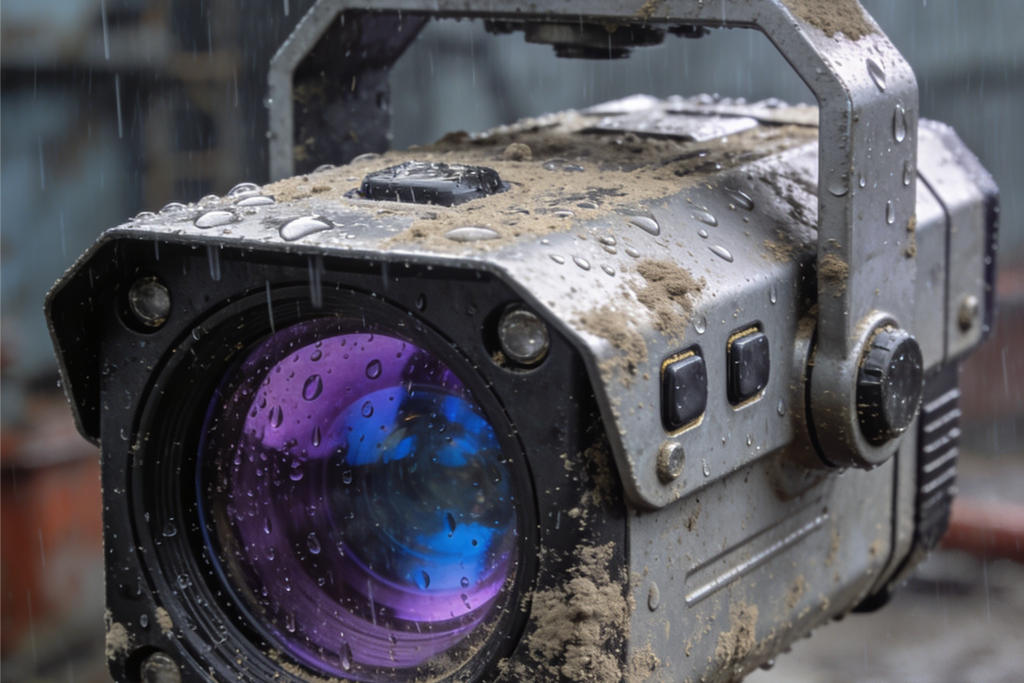
What Counts as a Harsh Environment?
Harsh environments for camera systems include:
Extreme temperatures – industrial freezers (-40°C), outdoor installations in cold climates, engine compartments, foundries, and furnace monitoring applications where ambient temperatures exceed +85°C.
Moisture and submersion – outdoor cameras exposed to rain and humidity, marine applications, food processing facilities with regular washdowns, and fully submersible systems for underwater inspection or filming.
Dust and particulates – mining, construction, cement plants, agricultural machinery, and any environment where fine particles can infiltrate electronics.
Vibration and shock – vehicle-mounted cameras, construction equipment, industrial machinery, and drone payloads where continuous vibration or impact loads are present.
Chemical exposure – food processing, pharmaceutical manufacturing, chemical plants, and offshore environments where corrosive substances contact the camera housing.
High pressure – subsea inspection cameras, pipeline inspection systems, and pressure vessel monitoring where the camera must withstand significant external pressure.
The Three Layers of Harsh Environment Design
Building a camera for harsh environments requires addressing three distinct engineering layers: the housing, the electronics, and the optics. Each layer has its own set of challenges and design requirements.
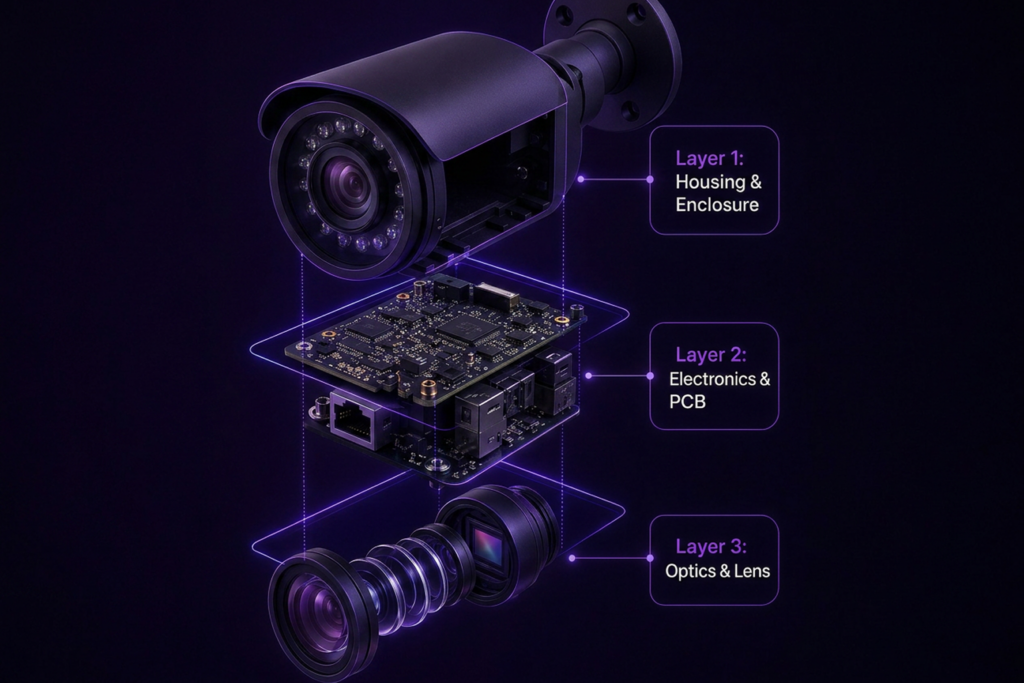
Layer 1: Housing and Enclosure Design
The housing is the first line of defense. Its job is to keep the environment out while maintaining thermal management and optical access.
IP and NEMA ratings define the level of protection against dust and water. IP67 means dust-tight and submersible to 1 meter for 30 minutes. IP68 means submersible beyond 1 meter at defined pressure. IP69K means resistance to high-pressure, high-temperature washdowns. Choose your target rating based on your actual deployment conditions – not the most demanding rating you can find.
Material selection matters more than it seems. Aluminum housings offer good thermal conductivity and corrosion resistance for most applications. Stainless steel is preferred for food processing and chemical environments. Engineered plastics (PEEK, Ultem) are used where weight or electrical isolation matters. For subsea applications, titanium or anodized aluminum with sacrificial anodes may be required.
Sealing strategy – O-ring seals are the standard approach for most IP-rated enclosures. For high-pressure applications, face seals or custom pressure housing designs may be required. Every penetration – cable gland, connector, optical window – is a potential leak path and needs careful design.
Thermal management – sealed enclosures trap heat. If your camera dissipates significant power inside a sealed housing, you need a thermal path to conduct heat to the outside. Options include thermal interface materials, heat spreaders, and conductive housings designed to act as heat sinks. Without thermal management, sealed cameras overheat and fail.
Layer 2: Electronics for Harsh Environments
Operating temperature range – standard commercial electronics are rated 0°C to +70°C. Industrial-grade components extend this to -40°C to +85°C. For the most extreme applications, military-grade components rated to -55°C to +125°C may be required. Designing for wide temperature ranges requires careful component selection, PCB layout, and thermal characterization.
Conformal coating – applying a thin protective coating to the PCB protects against moisture, dust, and chemical contamination that gets past the housing. Acrylic, polyurethane, silicone, and epoxy coatings each have different trade-offs in flexibility, chemical resistance, and reworkability.
Connector selection – standard connectors are not rated for harsh environments. M12 circular connectors with IP67/68 ratings are the industrial standard for harsh environment cameras. For subsea applications, wet-mate connectors rated for the operating depth are required.
Vibration resistance – PCB components can fail under sustained vibration. This requires attention to component mounting, PCB support and stiffening, and connector locking mechanisms that don’t loosen under vibration.
Layer 3: Optics for Harsh Environments
Optical window material – the lens or optical window is a weak point in any sealed camera. Standard glass can crack under thermal shock. Sapphire windows offer extreme hardness, scratch resistance, and wide temperature range – preferred for abrasive environments. Borosilicate glass offers good thermal shock resistance at lower cost.
Anti-fogging – when a cold camera is brought into a warm humid environment, the optical window fogs from the inside. Solutions include desiccants inside the housing, heater elements on the window, and nitrogen purging of the housing interior.
Lens selection – standard lenses are not designed for harsh environments. Industrial lenses with sealed focus and iris mechanisms, wide temperature range lubricants, and ruggedized barrels are required. For chemical environments, lens coatings must be resistant to the specific chemicals present.
Testing and Validation
Designing for harsh environments is only half the job. Validation testing confirms that the design actually works:
Accelerated life testing at elevated temperature and humidity to identify failure modes before field deploymen
Temperature cycling, thermal shock, humidity exposure, salt spray, and immersion testing to the rated IP level
Sinusoidal and random vibration testing, and drop/shock testing to relevant standards (MIL-STD-810, IEC 60068)
Working With a Partner on Harsh Environment Camera Development
Harsh environment camera development requires experience across mechanical engineering, electronics design, optical engineering, and materials science – as well as access to environmental test equipment. Getting it wrong means field failures, warranty returns, and potentially dangerous situations in critical applications.
At PieSoft, we’ve developed camera systems for pressure-rated camera, industrial, outdoor, and vehicle-mounted applications. If you’re building a camera for a demanding environment, get in touch — we’d be happy to discuss your specific requirements.
Learn more about our custom camera development services.


